Annual Reports
FactSet Research Systems Inc.'s annual reports contain management's most considered account of the business. These are the sections, passages and visual pages worth opening in the originals preserved in Sources.
FactSet Research Systems — FY2025 Annual Report (Form 10-K) — FY2025 (year ended Aug 31, 2025)
The latest 10-K: subscription model, the Sep-2025 CEO handoff, and a still-open IT material weakness. · Open the full document →
Item 1. Business — p. 7 · Read the full section →
Management's own framing of the platform, its client base, and the three-segment / firm-type structure.
Self-description: a subscription platform serving ~9,000 clients and over 237,000 professionals.
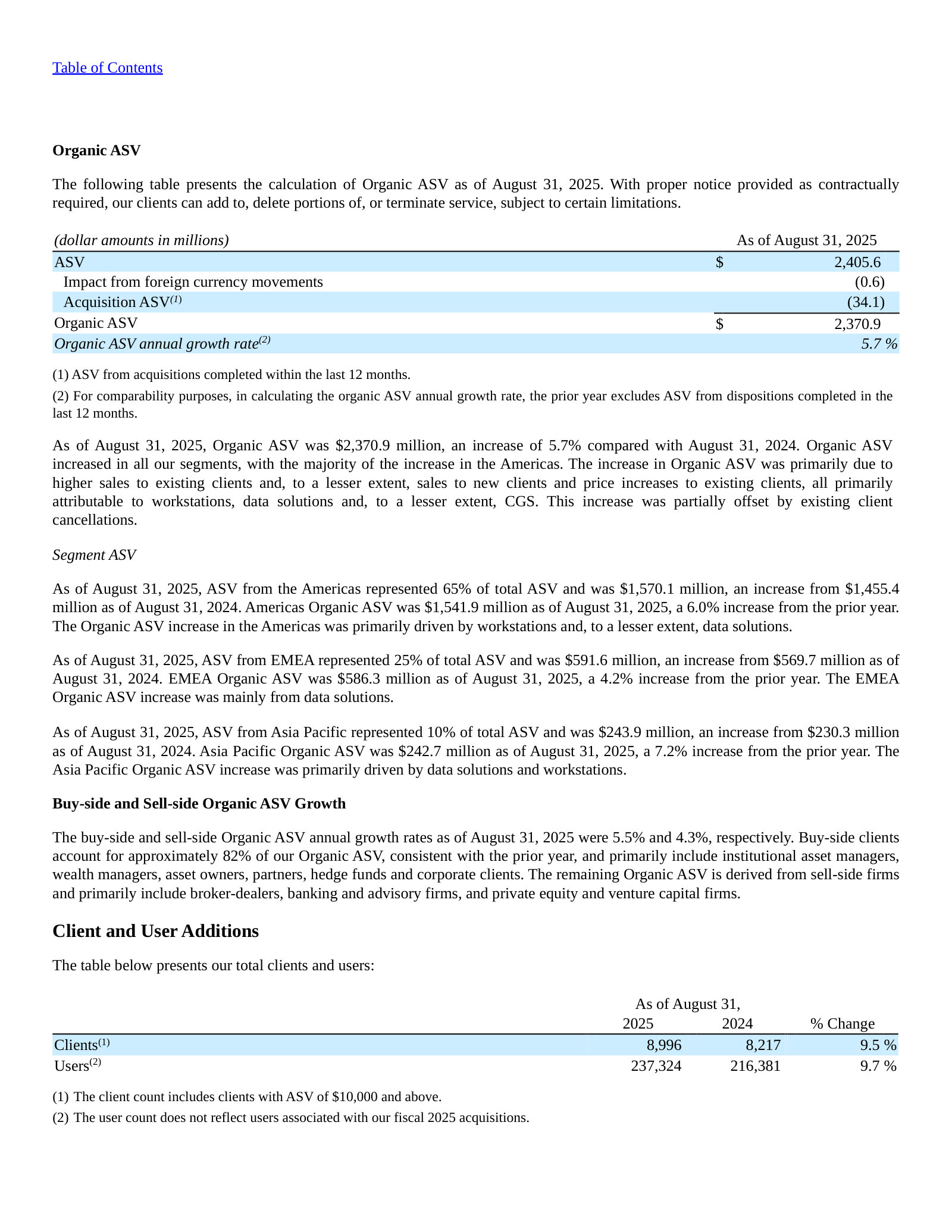
FactSet is a global financial digital platform and enterprise solutions provider with open and flexible technologies that deliver financial intelligence to investment professionals worldwide. […] As of August 31, 2025, we had approximately 9,000 clients comprised of over 237,000 investment professionals, including institutional asset managers, bankers, wealth managers, asset owners, partners, hedge funds, corporate users, and private equity and venture capital professionals. Our revenues are primarily derived from subscriptions to our multi-asset class data and solutions powered by our connected data and technology platform. Our products and services include workstations, portfolio analytics and enterprise data solutions.
p. 7 · Read in context →
Executive Leadership Transition — p. 11 · Read the full section →
A leadership change dated after fiscal year-end — the reader's first flag of a new strategic hand on the tiller.
Sanoke Viswanathan became CEO on Sep 8, 2025, succeeding retiring Philip Snow.
On September 8, 2025, Sanoke Viswanathan assumed the role of Chief Executive Officer and joined FactSet’s Board of Directors. Mr. Viswanathan succeeds F. Philip Snow, who retired from these roles effective on Mr. Viswanathan's start date. To support a smooth leadership transition, Mr. Snow is continuing employment with FactSet in an advisory capacity until December 31, 2025.
p. 11 · Read in context →
Revenues and Annual Subscription Value ("ASV") — p. 11 · Read the full section →
How FactSet actually makes money — recurring subscriptions measured by ASV, with the retention rate that underpins it.
The Competitive Landscape — p. 12 · Read the full section →
Management names its rivals — useful for sizing the moat against far larger data vendors.
Largest competitors: Bloomberg, S&P Market Intelligence, LSEG (Refinitiv); also Aladdin, MSCI, Morningstar.
Our largest competitors are Bloomberg L.P., S&P's Market Intelligence division, and London Stock Exchange Group's ("LSEG's") Data & Analytics division (formerly known as Refinitiv). Other competitors and competitive products include online database suppliers and integrators and their applications, such as BlackRock Aladdin, MSCI Inc. and Morningstar Inc. Many of these firms provide products or services similar to our offerings.
p. 12 · Read in context →
Item 1A. Risk Factors — p. 21 · Read the full section →
Two structural, company-specific risks that could genuinely bite: AI disruption and the active-to-passive shift.
AI risk: may not generate revenue from AI investment, and rivals may adopt it faster.
We use, and are expanding our use of, machine learning and AI technologies in our products and processes. If we fail to keep pace with rapidly evolving AI technological developments, or fail to launch products that are competitive, our competitive position and business results may be negatively impacted. If our competitors or other third parties incorporate AI technologies, such as emerging generative and agentic AI, into their products and processes more quickly or more successfully than us, this could impair our ability to compete effectively. Our use of AI technologies, including generative and agentic AI, requires resources to develop, test and maintain such products, which is costly. Despite our investments in, and commitment of resources to, the development of AI products and technologies, we may not be successful in generating revenues from these efforts.
p. 25 · Read in context →
A continued shift to passive investing could reduce demand for FactSet's active-manager clients.
A continued shift to passive investing, resulting in an increased outflow to passively managed index funds, could reduce demand for the services of active investment managers[…]
p. 27 · Read in context →
Item 7. Management's Discussion and Analysis of Financial Condition and Results of Operations — p. 45 · Read the full section →
Where management explains what drove fiscal 2025 — revenue, margin and EPS — plus the Organic ASV bridge.
Fiscal 2025: revenue +5.4% to $2,321.7M; net income +11.2%; Diluted EPS $15.55, +11.8%.
Revenues for fiscal 2025 were $2,321.7 million, an increase of 5.4% from the comparable prior year. The growth in revenues was driven by a 4.4% increase in organic revenues, a 0.9% increase from acquisition-related revenues and a net increase of 0.1% from foreign currency exchange rate fluctuations. Revenues increased in all our segments, primarily in the Americas. […] Net income for fiscal 2025 was $597.0 million, an increase of 11.2% from the prior year. Diluted earnings per common share ("Diluted EPS") for fiscal 2025 was $15.55, an increase of 11.8% compared with the prior year.
p. 47 · Read in context →
Item 9A. Controls and Procedures — p. 141 · Read the full section →
The standout governance flag — disclosure controls were not effective; a prior IT material weakness remains open.
Controls deemed not effective; the FY2024 IT general-controls material weakness continues, not fully remediated.
Our Principal Executive Officer and Principal Financial Officer have concluded that our disclosure controls and procedures were not effective as of the end of the annual period covered by this report due to a material weakness in internal control over financial reporting. This conclusion is due to a material weakness identified in the operation of certain key IT general controls. […] As reported in Part II, Item 9A. “Controls and Procedures” of our Annual Report on Form 10-K for the fiscal year ended August 31, 2024, we had identified a material weakness in the design and operation of IT general controls that support our revenues, accounts receivable, and deferred revenues processes which, in the aggregate, gave rise to a material weakness in internal control over financial reporting. While we have made significant progress remediating those control deficiencies, there remains certain deficiencies related to program change management and monitoring and user access in connection with segregation of duties and restrictions to appropriate users.
p. 141 · Read in context →
FactSet Research Systems — FY2024 Annual Report (Form 10-K) — FY2024 (year ended Aug 31, 2024)
Included to show where the material weakness originated — first disclosed here, with remediation promised for fiscal 2025. · Open the full document →
Item 9A. Controls and Procedures — p. 153 · Read the full section →
The first identification of the IT general-controls material weakness — read against FY2025 to see it left unresolved.
More annual reports
FactSet Research Systems — FY2023 Annual Report (Form 10-K) — FY2023 (year ended Aug 31, 2023) · 153 pages · Pre-material-weakness baseline under the Snow-era strategy and firm-type structure. · Open →
FactSet Research Systems — FY2022 Annual Report (Form 10-K) — FY2022 (year ended Aug 31, 2022) · 162 pages · First full year integrating the CGS (CUSIP Global Services) acquisition. · Open →
FactSet Research Systems — FY2021 Annual Report (Form 10-K) — FY2021 (year ended Aug 31, 2021) · 154 pages · Earliest edition on file — useful anchor for five-year ASV and margin trend. · Open →